
10 AI Cinematic Music Prompts for Film Scenes
10 AI cinematic music prompts for openings, dialogue, tension, pursuit, discovery and end credits, with a scene-first formula and revision checklist.
The word “cinematic” describes a broad family of sounds, not the dramatic job of a cue. A generator still has to guess whether the scene needs restraint, unease, acceleration or release.
A stronger brief begins with what changes on screen. It then defines the emotional point of view, pace, instrument palette, dynamic arc and the space needed for dialogue or effects. The examples below are original starting points, not guaranteed scoring outcomes.
Describe the dramatic turn before the sound
Write the scene in two beats: what is true at the start, and what has changed by the end. “A deserted station becomes threatening when the lights fail” gives the music a direction. “Dark cinematic music” only gives it a colour.
- Story event: arrival, discovery, separation, pursuit, confrontation or release.
- Point of view: whose fear, hope or uncertainty should the cue support?
- Movement: remain suspended, gather pressure, accelerate, break or resolve.
- Mix role: foreground statement, dialogue underscore or transition cue.
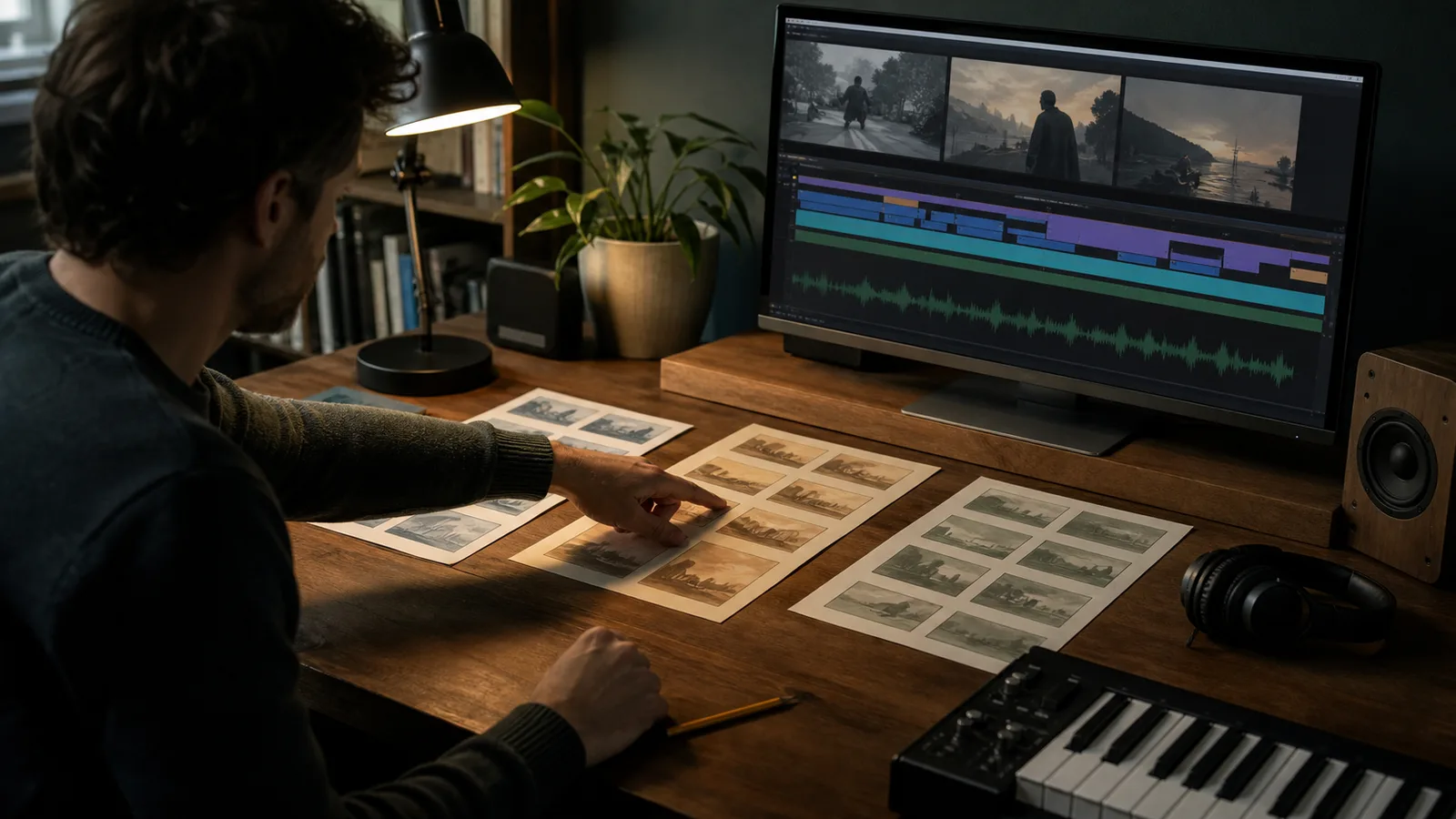
Use a scene-first cinematic prompt formula
Move from narrative function to audible decisions. Keep the palette small enough to hear which instruction changed the result.
Ten cinematic music prompts to adapt
Quiet opening
1. Quiet opening for an empty coastal town before sunrise, cautious rather than sad, very slow pulse, felt piano and thin high strings, wide sparse texture, one small motif appears twice, instrumental, restrained dynamics, end on an open sustained chord.
Discovery
2. Discovery cue as a hidden room opens for the first time, wonder mixed with uncertainty, slow rising pulse, glassy mallets, warm low strings and distant breathy woodwind, layers enter gradually, instrumental, reach one clear reveal and settle without a heavy impact.
Intimate dialogue
3. Underscore beneath a private conversation where trust begins to return, intimate and fragile, free-to-slow tempo, close piano, soft cello and faint room texture, minimal movement, instrumental, keep the middle range clear for speech, resolve gently without becoming sentimental.
Pursuit
4. Night pursuit through narrow streets, urgent but controlled, fast asymmetric pulse, tight low drums, short string figures and muted synth bass, energy rises in three stages, instrumental, avoid a heroic melody, cut to a brief dry ending.
Psychological tension
5. Psychological tension in a familiar room that slowly feels wrong, almost no beat, low bowed texture, detuned piano resonance and quiet granular clicks, small dissonances accumulate, instrumental, no jump-scare hit, finish unresolved.
Wonder
6. First view of a vast floating city, expansive and curious, moderate broad pulse, French horns, airy choir-like pad without words and shimmering percussion, melody climbs in short steps, instrumental, build once and then leave room for the image.
Science-fiction reveal
7. Science-fiction reveal as a dormant machine comes online, cold at first then quietly alive, slow electronic pulse, deep synth drone, metallic harmonics and one warm analog motif, layers synchronize gradually, instrumental, end with a steady unanswered signal.
Loss and reflection
8. Reflection after a character leaves home, restrained grief with a trace of acceptance, slow tempo, solo viola, soft piano and distant low strings, sparse phrases with long rests, instrumental, no large climax, close on an incomplete but calm cadence.
Restrained action
9. Action cue for a careful rescue rather than a battle, focused and tense, medium-fast pulse, dry percussion, low strings and short woodwind breaths, forward motion with controlled dynamics, instrumental, preserve space for alarms and effects, finish on a decisive stop.
End credits
10. End credits after an ambiguous ending, reflective with unresolved warmth, moderate-slow pace, return of a small piano motif with strings and muted electronic texture, expand the harmony gradually, instrumental, avoid a trailer climax, fade on a lingering question.
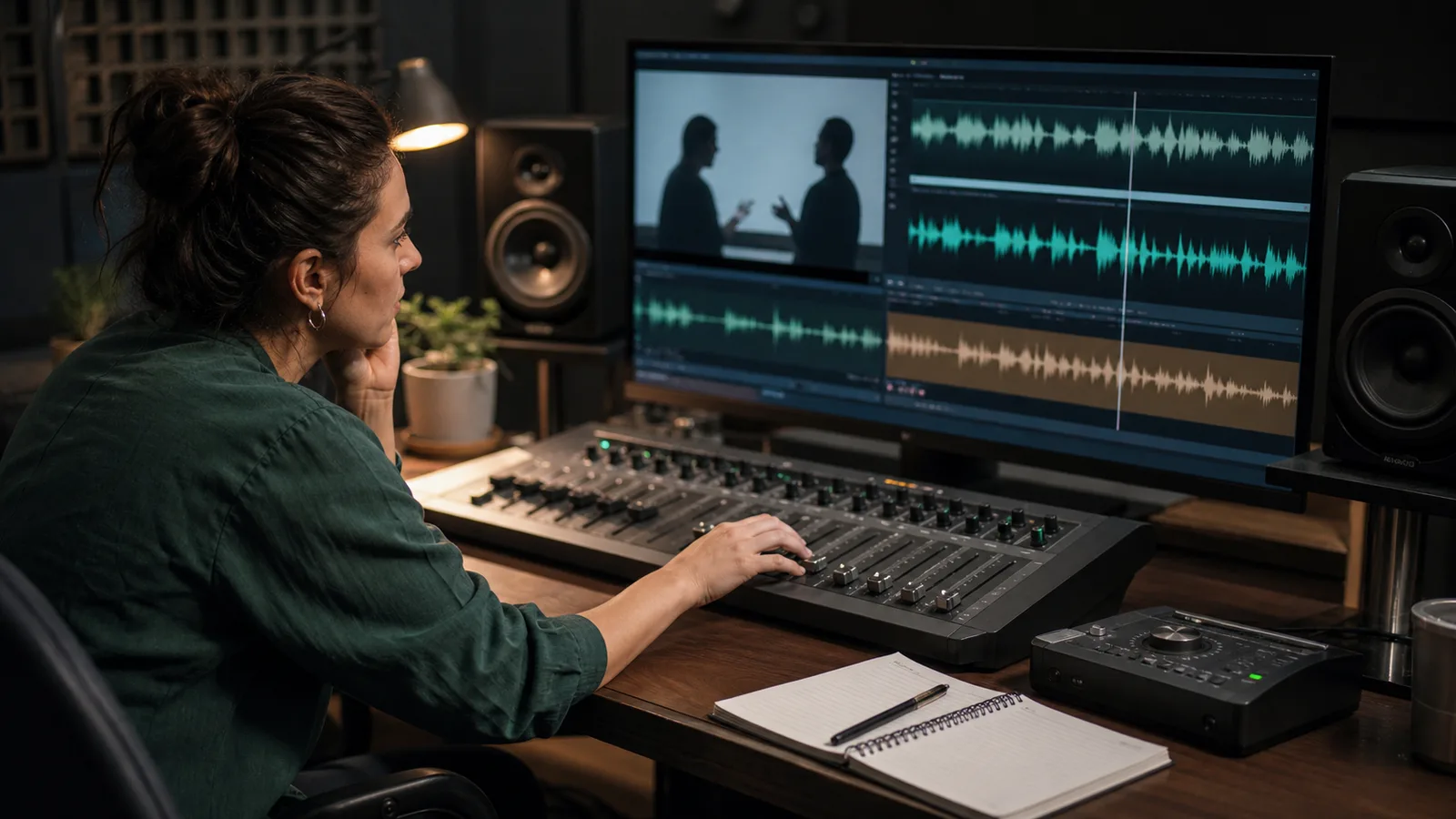
Test the cue against picture and dialogue
- 01
Spot the scene with temporary audio
Play the cue against the actual cut. Mark the exact frame where the emotional direction changes rather than judging the track in isolation.
- 02
Listen once for dialogue
Check whether melody, percussion or dense midrange pulls attention away from speech and important sound effects.
- 03
Check the arc
The largest musical change should support the scene's turning point. If it arrives early, reduce or delay the build.
- 04
Write one time-coded note
A note such as “low drums become too large at 00:24” is easier to revise than “make it more cinematic.”
Revise the dramatic mismatch, not every detail
Keep the scene, point of view and sounds that already work. Change the most important mismatch: flatten an oversized build, remove an attention-grabbing lead, delay the reveal or thin the texture under dialogue. Compare the next draft against the same cut before changing another variable.
How this guide was prepared
These prompts are original editorial templates based on observable scene, texture, rhythm, instrumentation and dramatic-arc decisions. Berklee's film-scoring material was used to verify the emphasis on narrative function, emotion, form and orchestration. Google’s music-prompt guide was used to check current prompt controls. No example is copied from an existing score or presented as a benchmark result.
Frequently asked questions
What should an AI cinematic music prompt include?
Include the scene, turning point, emotional perspective, pace, a focused instrument palette, texture, dynamic arc, mix role and ending.
Is cinematic music always orchestral?
No. A cinematic cue can be orchestral, electronic, acoustic or hybrid. The word describes its relationship to the scene more than one fixed instrument set.
How do I keep cinematic music under dialogue?
Ask for restrained dynamics, sparse midrange activity and no dominant lead melody, then test the generated cue beneath the real speech.
Should I name a film composer in the prompt?
It is clearer to describe instruments, texture, pacing and dramatic movement directly. This also avoids making a living artist's identity do the work of a precise brief.
Related guides
How to Make AI Music from a Text Prompt
A practical walkthrough for describing the style, mood, instruments, tempo, and structure you want before generating music.
Prompts30 AI Instrumental Music Prompt Examples by Use Case
A broad prompt library for creating music without vocals, with a reusable formula for controlling mood, instruments, pace, and arrangement.
WorkflowsHow to Write AI Music Prompts Without Vocals
A focused workflow for getting instrumental results without conflicting lyric or singer instructions.
Try these AI music tools
Start creating